


Events
Find information about the Bureau's technical assistance events below.
Dear guests,
We regret to inform you that we have postponed the P3 Showcase scheduled for October 27 and 28.
We appreciate your interest in the event and in increasing private investment in American infrastructure. We look forward to seeing you at future events.
Thank you,
Build America Bureau
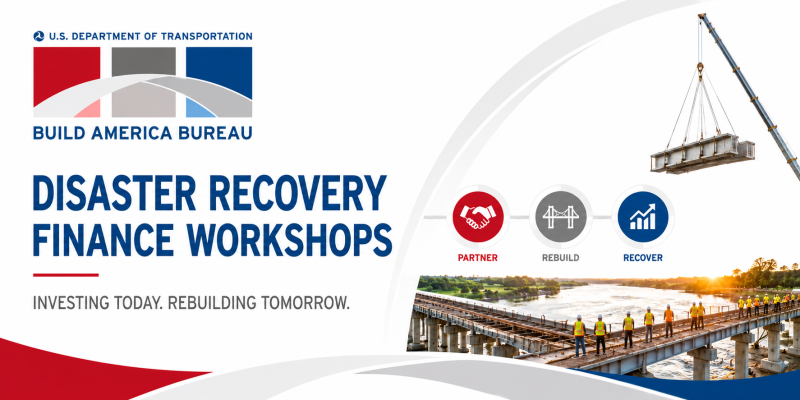
American transportation infrastructure faces increasing exposure to natural disasters, with damages exceeding $20 billion annually, according to Federal Highway Administration (FHWA) data from 2020 to 2024, with Hurricane Harvey alone generating $45 billion in transportation impacts during 2017. While FHWA’s Emergency Relief Program and the Federal Emergency Management Agency Public Assistance program provide partial relief, other tools could be deployed to help communities recover. Recently, U.S. Department of Transportation (USDOT) Secretary Sean P. Duffy announced expedited federal support and more than $2.6 billion in Federal funding to help States and U.S. territories pay for repairs to roads, bridges, and other transportation infrastructure damaged by natural disasters.
The Bureau will host three regional workshops for states and localities impacted by national disasters. These three workshops will provide State and local decision makers technical assistance on available Federal resources and promote the use of the Transportation Infrastructure Finance and Innovative Act (TIFIA) and the Railroad Rehabilitation and Improvement Financing (RRIF) master credit agreements (MCA) to bridge the gap between immediate disaster impact and long-term fiscal resilience. An MCA allows USDOT to provide a conditional commitment to a program of related projects up to a specified cap, with individual loans executed after projects are defined and requirements satisfied. The workshops will be customized to address the unique characteristics of the host regions for State and local decision makers, each headlined by a USDOT senior leadership representative.
Check back soon for more information about the workshops.
Master Credit Agreements
Master Credit Agreements (MCAs) under TIFIA and RRIF allow the DOT to expedite state infrastructure financing. Instead of immediately obligating Federal funds, an MCA creates a pre-negotiated framework and conditional commitment for a program of related projects up to a specified cap ($500 million to $2 billion). Individual loans are executed later as specific projects are defined and satisfy Federal requirements.
Key Benefits for Disaster Recovery
The Bureau uses MCAs as pre-positioned tools to streamline post-disaster financing by allowing States to:
- Aggregate multiple recovery projects under a single, common security pledge.
- Establish a 5-year "preparedness horizon" for long-term infrastructure resilience.
- Drastically shorten approval timelines after a disaster strikes by using pre-negotiated terms.
Requirements & Compliance
To qualify, the MCA must be backed by high-investment-grade, non-Federal revenue (such as State general obligation bonds or legislative appropriations). Funds are formally obligated only after projects meet all statutory requirements, including project-specific environmental reviews (NEPA) and final financial close within the 5-year window.
Note: While the same framework applies to RRIF MCAs, they are limited to fewer eligible project types under the statute compared to TIFIA.
For more information about the Bureau's credit programs, please see the Credit Programs Guide.
Resources
For more information:
The future of American infrastructure isn’t just about what we build—it’s about how we build it. We’re thrilled to share that the Build America Bureau is hosting a pivotal event: Public-Private Partnerships (P3s) Forum: Scaling Up Innovative Approaches for Accelerated Delivery. This isn't just another gathering. It is a strategic move designed to bridge the gap between federal policy and local execution. We are bringing together USDOT leaders, state and local officials, and industry powerhouses to turn "innovative financing" from a buzzword into a blueprint for action.
Event Details
When: April 30, 2026 | 9:00 am – 5:00 pm
Where: 1200 New Jersey Ave SE, Washington, DC (In-person registration has closed)
What to Expect [Download Full Agenda]
The day is structured for high-impact engagement:
Morning: High-level panel discussions with federal, state, and private decision-makers.
Afternoon: Targeted breakout sessions to dive deep into strategic opportunities through collaborative discussions.
Networking: Unparalleled access to the stakeholders shaping the next decade of U.S. infrastructure.
Note: If you require specific accommodations, please reach out to buildamerica@dot.gov.
Resources
For more information, view the Public-Private Partnerships (P3) page.