


ICYMI: U.S. Transportation Secretary Sean P. Duffy Provides Update on Restoration of Airspace Following Nationwide Ground Stop
WASHINGTON, D.C. – U.S. Transportation Secretary Sean P. Duffy and Federal Aviation Administrator (FAA) Bryan Bedford provided updates on what led to the FAA’s nationwide ground stop on November 13, 2026, and the restoration efforts the Department took to reopen the airspace safely and quickly.
REMINDER: Telecommunications issues that impacted the stability of communications and radar systems utilized by Air Traffic Control led the FAA to issue a nationwide ground stop out of an abundance of caution. FAA’s incredible air traffic controllers and commercial pilots were responsible for safely and efficiently grounding over 3,500 flights swiftly. Once the ground stop lifted, over 8,000 flight operations resumed last night alone. Today, the airspace is open, however, passengers should be prepared for some delays and cancellations as flights resume.
Watch the full press conference HERE.
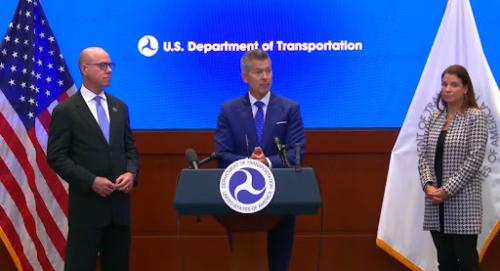
Secretary Duffy on the work done by air traffic controllers and pilots to land Americans safely yesterday:
“I just want to, again, start off and thank our air traffic controllers and our pilots. They exhibited an amazing performance yesterday. We had 3,500 aircraft in the air. We had a ground stop and they safely landed all of our aircraft which was outstanding. But I also want to thank our flight attendants, our ground crews, our airport authorities. All of them rallied yesterday. A lot of passengers at airports. They all came together and served the American people incredibly well. I also want to thank the passengers. I know a lot of people were disrupted. Whether they were going on vacation, they were coming home from work–they had significant disruption and the patience that they exhibited. We at the DOT and the FAA are grateful for that patience.”
Secretary Duffy on what led to the issue:
“Now, those of you who are aviation reporters have heard me talk about a decades old air traffic control system. It's not just old equipment. We have an incredibly old telecommunication system. And so, here's what we believe happened yesterday:
- In at least one of our remote FAA locations, a contractor was doing routine maintenance to switch telecommunication lines from old copper wire and they were bringing it over to fiber. That contractor that does the work for us is L3Harris. They're our legacy provider. They've been working for the FAA for over 20 years, and the network that we use at the FAA to control the airspace, L3Harris actually owns that network.
- Now, the work happening was due to the age of the copper wire that we were replacing. It was such an old wire that it was being discontinued, meaning that line was going to get shut down. So we had to switch it over from old copper. We had to bring it over to fiber going from TDM to IP—or from analog to digital.
- I want to be clear: this work has been happening in America for decades. Virtually every single institution in America has gone from copper to fiber, from analog to digital. Maybe the FAA is the last one to be doing this work because the investments haven't been made. But this is not complicated. It's pretty straightforward work that we were doing yesterday at, again, a very remote location.
- So what we're working to determine was whether we had incompetence, meaning was it user error or install error from L3Harris or did they install a faulty router? We haven't determined what the fault was. Was it the router or were they not doing great work for us at L3Harris? Either through contractor error or a faulty piece of equipment, that router that was being replaced as we switched from copper to fiber, it started flooding other routers in our air traffic control system.
- So, specifically, we had over 1,000 connection attempts every four to five seconds. And what that did was give us issues with our communication with airplanes and it also caused some disruption with our radar feeds. And when we see that—your safety is paramount—we shut down the airspace and we do it safely. We get you on the ground and then we work on isolating the problem and then opening the airspace back up, which is what we did yesterday.”
Secretary Duffy on whether the inconsistencies were caused by a cyber attack:
“We don't believe so. Once we were able to isolate the work that was being done at this remote location, all of our systems came back online. So, we don't believe this was cyber at all.”
Secretary Duffy on the safety of the national airspace:
“To the American traveler, our number one job is their safety and Bryan [Bedford] mentioned this and I’ve mentioned this before but we will keep you on the ground, you won’t get to your destination if we think you can’t get there safely. My first day on the job was the DCA air crash…My heart goes out to those families and everyone who has lost someone in aviation. We do everything we can to keep travelers safe and our airspace is safe. I fly all the time, my kids fly, my wife flies. This is a safe system, evidenced by what happened yesterday. If there is any issue with our telecom…we shut the airspace down. We brought airplanes in, we landed them safely, we figured out what was wrong, our systems came back online and have become fully operational. That’s how seriously we take safety.”
Secretary Duffy on the FAA’s progress modernizing America’s air traffic control system:
“The Congress gave me a partial payment. They gave me $12.5 billion. And one of the problems that we had was [Congress] weren't quite sure that we would spend the money well and we'd build with the money. And that's the history of the FAA that goes back from Republicans and Democrats. They haven't spent the money well. So, they want to make sure we're going to spend and spend it well. And we have. And so, in the course of the last year, since I've got that $12.5 billion, I want to talk to you about what we've actually accomplished.
- So, we have replaced 69% of the copper communications.
- We moved that over to high-speed fiber…
- We've deployed Surface Awareness Initiative initiative technology at 143 control towers. So instead of just looking out the tower with binoculars, we have a digital screen and representation of the airfield, giving an extra tool for air traffic controllers to drive safety whether there's weather or fog or there's an issue with line of sight, driving safety into the airspace.
- We've converted 469 radio sites to modernize those systems. So, using 30-year-old radios, upgrading them to have crisper, clearer communication between air traffic controllers and pilots is critical because we rely on this communication to keep the airspace safe.
- We've installed electronic flight strips at 25 towers. We still use paper flight strips, which is 1970s technology. An airplane has passed from one controller to the next using a paper flight strip. We're moving to electronic flight strips.
- We've installed 224 IP voice switch systems at towers. We've installed 18 new tower simulator systems and
- We've installed nine SMR4 surface movement radars. So, we are building. We are building safely, but we are building fast.”
Secretary Duffy on the need for Congress to fully fund air traffic control modernization:
“I hope that they meet this moment and they invest in what will be the state-of-the-art, the best-in-class, best in the world air traffic control system. When I came in, President Trump, before the DCA air crash, was saying, ‘We have to modernize our airspace. I want you to work on modernizing air traffic control.’...and then if you look at the Congress–that you have both Democrats and Republicans who understand how important this is. For me, it gets to be frustrating where everyone says they want to do it and the president is pushing it but we don't get the resources. And I think this is the moment. If we don't start to switch out our systems, how long are we going to wait? I think this is a sign for [Congress] to lean in. This is bipartisan….We should be able to rely on our air traffic control system—making sure it works… Let’s not let the legacy of the past where investments weren't made, which is why we are here today. Let's make the investments and look forward to a brighter future in aviation, a safer future, a more efficient future in aviation.”
FAA Administrator Bedford on how the issue is unrelated to USDOT’s ongoing modernization efforts:
“I think we’re conflating ‘Modernization’ with this upgrade at this particular facility. We spend a billion dollars a year maintaining and sustaining the existing 1980’s TDMI telco network—call it 1G, the 1G system that the FAA is on. So we are constantly replacing 2,000 Cisco 600 routers with Juniper routers. So, this is ordinary course-of-business stuff, this is not part of the Peraton-FAA $12.5 billion modernization effort, so let’s not conflate those two things.”
Secretary Duffy on the timing of the upgrade:
“We're making the transition because it's safer and it's more resilient. But because of the nature of what this switchover was, it was a remote location, we'll do those during the day. Now, if we're going to be at Newark, if we're going to be, you know, in one of our big facilities, those switchovers happen at night and they can have a bigger impact. But these smaller locations don't have that kind of impact—or they shouldn't have that kind of impact which is what we saw yesterday. So, there'll be a reevaluation of when we do this work. But when you look across the country when the work has been done from copper to fiber, going from analog to digital, they've happened at all times of the day, and so we have to drill in a little further about what happened here.”
###