


THE FUTURE OF AVIATION IS HERE: Trump’s Transportation Secretary Sean P. Duffy and FAA Unveil Eight Selections for Pilot Program Testing Next-Gen Aircraft in America’s Skies
‘eVTOLs & advanced air mobility aircraft will radically redefine personal travel, regional transportation, cargo logistics, emergency medicine, and so much more’
WASHINGTON, D.C. – U.S. Transportation Secretary Sean P. Duffy and the Federal Aviation Administration (FAA) today announced eight proposals were selected as part of the brand-new Advanced Air Mobility and Electric Vertical Takeoff and Landing (eVTOL) Integration Pilot Program (eIPP). eVTOLs are futuristic aircraft that have the potential to generate new jobs, connect communities, and strengthen American leadership in aviation.
Click the image above to watch the announcement video
This first-of-its-kind program, which was outlined in President Trump’s Unleashing Drone Dominance Executive Order, is accelerating the safe integration of next-generation Advanced Air Mobility aircraft into the national airspace and ensuring the United States leads the way in aviation innovation.
Together, these pilot projects will create one of the largest real-world testing environments for next-generation aircraft in the world. In addition to offering the American people an exciting window into the future of aviation, data from the pilot projects will be used by the FAA to develop new regulations that safely enable this futuristic technology at scale. The American public will start to see operations begin under this program by summer 2026.
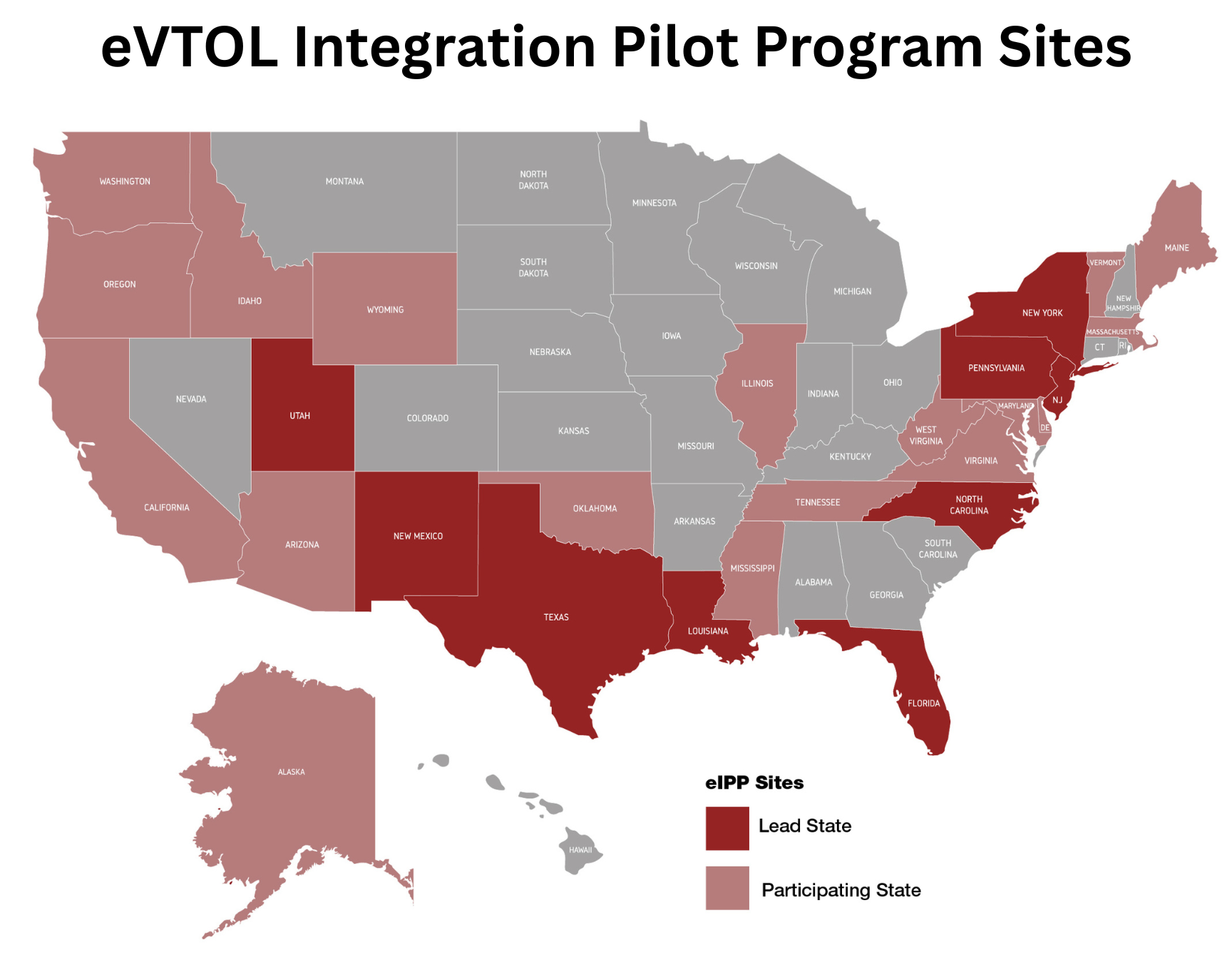
The eight selected projects span 26 states and involve leading aircraft manufacturers, operators, and state partners. They include a range of operational concepts, including:
- Urban air taxi services
- Regional passenger transportation (including short Takeoff and Landing aircraft)
- Cargo and logistics networks
- Emergency medical response operations
- Autonomous flight technologies
- Offshore and energy-sector transportation
“Thanks to President Trump, the future of aviation is here — and it’s going to dramatically improve how people and products move,” said U.S. Transportation Secretary Sean P. Duffy. “Congratulations to the great American innovators behind each of these exciting pilot programs. Working together, we will ensure America leads the way in safely leveraging next-gen aircraft to radically redefine personal travel, regional transportation, cargo logistics, emergency medicine, and so much more.”
“These partnerships will help us better understand how to safely and efficiently integrate these aircraft into the National Airspace System,” said FAA Deputy Administrator Chris Rocheleau. “The program will provide valuable operational experience that will inform the standards needed to enable safe Advanced Air Mobility operations. We appreciate the strong interest reflected in the many proposals we received.”
Specifics on Selected Projects
The following projects were selected to participate in the eVTOL Integration Pilot Program:
Port Authority of New York and New Jersey
Multiple industry partners will collaborate on 12 different operational concepts across New England, including eVTOL passenger operations at the Manhattan heliport.
Partners: Archer, BETA, Electra, Joby
Texas Department of Transportation
Industry partners will support regional flights connecting Dallas, Austin, San Antonio, and eventually Houston, with air taxi networks expanding from each city to extend regional reach.
Partners: Archer, BETA, Joby, Wisk
Utah Department of Transportation
Four states spanning the Pacific Northwest, the Rocky Mountains, and the Plains of Oklahoma will test a wide range of next-generation aircraft and operational concepts.
Partners: Ampaire, BETA, Joby, Other
Pennsylvania Department of Transportation
The NASAO AAM Multistate Collaborative will work across 13 states to revitalize regional flights across the country, including routes similar to those supported through the Essential Air Service program.
Partners: BETA, Electra, Other
Louisiana
Operations will test cargo and personnel transportation capabilities to enable flights over the high seas into the Gulf of America and to energy industry locations in Louisiana, Texas, and Mississippi.
Partners: BETA, Elroy Air, Other
Florida Department of Transportation
A statewide effort featuring multiple industry partners will include three phases of operations focused on cargo delivery, passenger transportation, automation, and medical response, supported by significant public and private investment.
Partners: Archer, BETA, Electra, Joby, Other
North Carolina Department of Transportation
Working with industry partners to establish piloted medical and regional operations across the state while also developing an autonomous flight operation extending into Virginia.
Partners: BETA, Joby, Other
City of Albuquerque
A focused project designed to achieve early advances in autonomous operations through an existing partnership with an advanced autonomy developer already operating in the region and coordinating with the FAA.
Partner: Reliable Robotics
Background
The Advanced Air Mobility and eVTOL Integration Pilot Program (e-IPP) received more than 30 proposals from across the country. Submissions were evaluated by a technical review team from DOT and FAA.
Proposals were assessed based on their ability to accelerate the integration of Advanced Air Mobility aircraft, the breadth of operational concepts proposed, potential regulatory and policy insights, experience in aircraft development or manufacturing, and the strength of industry, academic, and government partnerships.
Following this review process, the eight projects listed above were selected to advance the next phase of the program.
###